
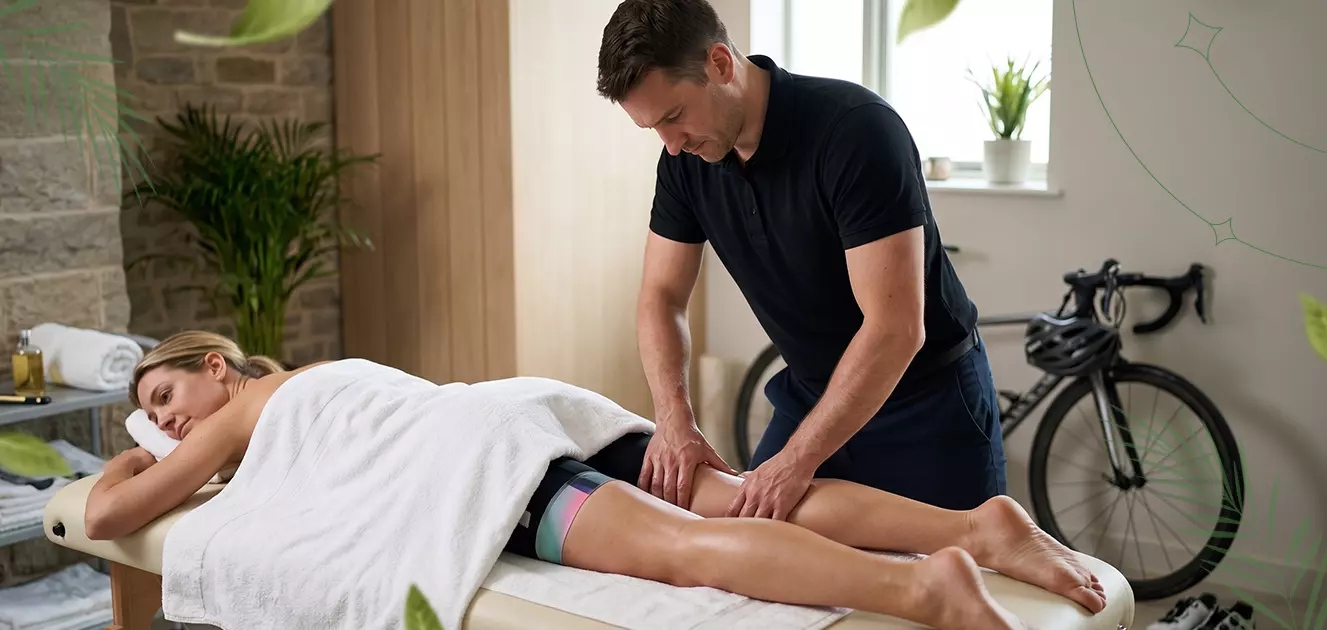
Sports massage for cyclists can help ease soreness, reduce muscle tightness, and support faster recovery between rides. While it is not a replacement for rest or nutrition, it can be a valuable part of a cyclist’s recovery routine.
You get home from a long Sunday ride. Your lower back has been complaining since mile 30. And that IT band issue you have been quietly ignoring for 3 weeks? It is officially back. Most cyclists do everything right on the bike. They track their zone, nail their nutrition, and follow a structured plan. Then they skip the one thing that actually helps their body absorb all that training: proper recovery.
Sports massage is not a treat for pro cyclists. It helps you recover faster between rides, stay injury-free, and keep improving without constantly feeling beaten up. This blog post covers what a sports massage actually does for cyclists, which techniques your therapist should be using, how to time it around your training week, and what areas should never be massaged.
What actually happens in a cyclist’s sports massage?
A sports massage for cyclists is a targeted treatment that uses deep-tissue pressure, myofascial release, and trigger-point therapy to address muscle imbalances caused by cycling. Unlike a relaxation massage, it focuses on the glutes, quads, hamstrings, and lower back. The therapists begin with a brief assessment before addressing your specific problem areas.
Before anything else, it helps to understand what makes a cyclist’s massage different from a general spa treatment. When you sit down for a sports massage, the first thing a good therapist does is ask questions, how many miles are you riding per week? Which leg feels tighter? Any upcoming events? Where exactly does it hurt? That five-minute conversation shapes everything that follows.
It is not a relaxation massage
A sports massage can be uncomfortable, particularly the first time. Deep pressure on your IT band or sustained compression on a glute trigger point will not feel anything like a hot stone treatment. The therapist is working through layers of muscle that have been contracting thousands of times per ride, often in a shortened position, with very little of the natural lengthening that walking provides. Getting those tissues to release properly takes real pressure. The discomfort usually fades within a day. What follows is noticeably freer movement and lighter legs.
Why cycling creates specific muscle problems
Cycling is a repetitive movement. Your muscles shorten and contract during the pedal stroke, but rarely reach the full lengthening they need to recover properly. And in the sustained position on the bike, hunched over the bars with hip flexors shortened, lower back loaded, and chest compressed, you end up with the kind of muscle imbalances that quietly chip away at your performance and comfort over weeks and months.
The main areas that take the most strain are:
- Glutes, often underused, are frequently tight and important for climbing power.
- Hamstrings, which work eccentrically through the stroke and tighten over long rides.
- The IT band and hip flexors are the most common sources of chronic cycling pain.
- Calves are held in a shortened position for most of each ride.
- The lower back is continuously loaded in the riding position.
- Upper back and shoulders, tensed from gripping the bars for hours.
A cyclist-specific massage addresses all of these together rather than just the sore spot. Lower back pain in a cyclist is almost always connected to tight hip flexors. Knee pain usually traces back to the quadrant tendon. A good therapist joins those dots.
Benefits of sports massage for cyclists
Sports massage helps cyclists recover faster, reduce injury risk, improve flexibility, and increase blood circulation. Cyclists who receive regular sports massage can see up to 20% improvement in recovery time. There are also psychological benefits, including lower stress levels and improved mental focus heading into the next session. If you have ever wondered whether sports massage actually makes a measurable difference, here is what the research shows.
It prevents injuries before they start
This is probably the biggest benefit of sports massage, and it is the one most cyclists miss until they are sitting on a physio table, wondering how their knee got this bad. A sports massage therapist will often spot tight bands and trigger points that are heading towards injury before they actually get there. They will find the IT band that is two hard rides away from friction syndrome. They will identify the quad adhesion that is slowly pulling the kneecap out of alignment. Catching those issues early costs far less than a month off the bike.
It improves your position and power output
Tight hip flexors are one of the most common reasons cyclists cannot achieve the saddle height their bike fit prescribes. Stiff hamstrings reduce power through the bottom of the pedal stroke. A locked thoracic spine makes it painful to hold an aerodynamic position for more than 20 minutes. Regular sports massage loosens all three. The result is not just comfort; it is measurable improvement in how efficiently you transfer power to the pedals.
The mental side that often gets overlooked
Cycling is mentally demanding, particularly when you are managing a structured training plan alongside work and everything else. That chronic low-level stress sits in your nervous system as much as your muscles. Deep tissue work triggers a parasympathetic nervous system response. Heart rate drops. Cortisol falls. Endorphins are released, the same effect as a good ride. Professional cyclists use massage between race stages partly as a mental reset. The same benefit is available to the rest of us.
Sports massage techniques your therapist should be using
The main techniques used in a cyclist’s sports massage are effleurage (long, warming strokes), petrissage ( deep kneading of muscle tissue), and deep tissue friction.
(for scar tissue and adhesions), myofascial release ( for fascia and IT band tightness), and trigger point therapy ( sustained pressure on knots, held for 8 to 10 seconds). Most sessions combine several of these depending on what you need. Not all messages are the same. Here is what each technique does and why it matters for your riding.
- Effleurage
Every session starts here. Long, gliding strokes across the muscle increase surface blood flow, warm the tissue, and prepare it for deeper work. If a therapist skips this and jumps straight into deep pressure, that is worth noting. Effleurage also closes a session. The same light, flowing strokes are used at the end to flush the tissue and calm the nervous system after heavier work.
- Petrissage
This is the kneading and squeezing technique most people associate with massage. It works deeper into the belly of the muscle to release knots and improve tissue pliability. For cyclists, it is most effective on the quads, hamstrings, and calves, the muscles that accumulate the most tension from repetitive pedalling.
- Deep tissue friction
Sustained, deep circular pressure is applied to areas of adhesion or scar tissue, often around the knee, along the IT band, and in the lower back. This tends to be the most uncomfortable part of the session. If your therapist finds a spot that makes you want to move off the table, they have probably found exactly what they were looking for. The discomfort usually resolves within 24 hours and is followed by noticeably improved mobility.
- Myofascial release
Fascia is the connective tissue that wraps around every muscle. When it tightens from cycling, particularly in the hip and IT band area, it restricts movement across entire muscle groups rather than just locally. Myofascial release uses slow, sustained pressure and stretch to free those restrictions. It is particularly effective for IT band syndrome and hip flexor tightness.
- Trigger point therapy
A trigger point is a hyperirritable spot in a muscle, which most people call a knot. When pressed, it produces local pain or referred pain elsewhere in the body. The therapist isolates the trigger point and holds steady compression for 8 to 10 seconds until the tension releases. This is especially valuable for lower back pain and glute tightness in cyclists, where referred pain patterns can make the actual source hard to identify.
| Pro tip: Before your session, tell your therapist which side feels tighter, whether you have been favouring one leg, and what your weekly mileage looks like. A focused 60-minute session on your actual problem areas will do more for you than a generic 90-minute treatment that covers everything lightly. |
The 80/20 training rule and where sports massage fits in
The 80/20 rule in cycling means spending 80% of training time at low intensity (Zone 1 to 2, below lactate threshold) and 20% at genuinely high intensity (Zone 4 to 5). First identified by sports scientist Dr Stephen Seiler, the model works by building aerobic capacity without burning you out. Sports massage is part of what makes the easy 80% genuinely restorative rather than just slow riding on tired legs. If you follow a structured training plan, you have likely come across the 80/20 model. Here is why it matters and how massage fits into the picture.
Where massage changes the equation
When your muscles are carrying accumulated tension from the previous training week, your easy Zone 2 rides become harder than they should be. Heart rate creeps up. Legs feel heavy. What should be restorative ends up adding to fatigue. Regular sports massage interrupts that pattern. By clearing tension, restoring circulation, and addressing the restrictions that limit movement, it lets your low-intensity training do what it is supposed to do: build your aerobic base without grinding you down.
How often should cyclists get a sports massage?
Cyclists training 3 to 4 times per week benefit from one sports massage every 2 to 4 weeks for general maintenance. During heavy training blocks or competitive season, every 7 to 10 days produces better results. The standard session length for most cyclists is 60 minutes, which allows enough time for a proper assessment and treatment of the primary and secondary problem areas.
30 minutes, 60 minutes, or 90 minutes?
A 30-minute session is useful when you have one specific area causing a problem, a tight IT band, a sore calf, or a lower back flare-up. The therapist can focus properly and get results without spreading the session too thin.
A 60-minute session is the standard for most cyclists. It allows for a proper assessment, through work on the primary areas (glutes, quads, hamstrings, IT band), and attention to secondary areas like the calves and lower back.
A 90-minute session is worth booking after a big event, such as a century ride or multi-day sportive, or if you have multiple problem areas that need addressing at the same time. It is also the sensible choice if you have been avoiding massage for months and are working through significant accumulated tension.
Self-massage between appointments
Professional sessions get the best results, but you can slow the rate at which tension rebuilds between appointments. A foam roller used for 10 to 15 minutes after each ride, targeting the quads, IT band, calves, and thoracic spine, is the most effective home tool. A massage stick works well for the calves when you are short on time. A lacrosse ball or massage ball used against a wall can release glute and hip flexor trigger points on rest days.
Common cycling injuries that sports massage can help with
The most common cycling injuries that respond well to sports massage are IT band syndrome, patellar tendonitis, patellofemoral syndrome, lower back pain, tight hip flexors, and calf tightness. In each case, the massage targets the surrounding musculature and root cause rather than applying pressure directly to the inflamed tissue. If you are already dealing with an injury, here is how massage fits into the recovery process.
IT band syndrome
IT band friction syndrome is probably the most common overuse injury in cycling. The repetitive pedal stroke, combined with tight hip abductors and glutes, builds tension along the lateral thigh that eventually becomes painful around the knee. Myofascial release and deep friction work along the IT band can significantly reduce that tension. It is also considerably more tolerable than foam rolling the same area, which many cyclists find unbearably painful. Massage alone will not fix IT band syndrome permanently, though. Hip abductor strengthening work needs to run alongside treatment; the root cause remains.
Knee pain
Most cycling-related knee pain starts in the quadriceps rather than the knee itself. Tight quads create downward pressure on the patella, leading to patellar tendonitis or patellofemoral syndrome over time. Deep tissue work on the quad, the teardrop-shaped muscle just above and inside the knee, relieves that pressure. Most cyclists notice improvement within one or two sessions.
| Never massage directly over a swollen, inflamed knee. Work the surrounding musculature and let the acute phase settle first. |
Lower back pain
Lower back pain is extremely common in cyclists and almost always has the same root cause: tight hip flexors combined with a weak posterior chain. Time in the riding position shortens the hip flexors and loads the lumbar spine. Over months, this creates a forward pelvic tilt that puts the lower back under continuous strain.
A good massage for cycling lower back pain works the hip flexors, glutes, and erector spinae together. The thoracic spine and shoulder area should be part of the treatment too, because the whole chain from neck to pelvis is involved.
Tight calves and Achilles issues
Cycling keeps the calf in a shortened position throughout most of the pedal stroke. Left unaddressed, that tightness migrates to the Achilles tendon, which then becomes vulnerable to tendinopathy. Petrissage on the gastrocnemius and soleus works well here. If the Achilles itself is already inflamed, the therapist should work the calf belly only and stay away from the tendon until the inflammation settles.
What parts of the body are not allowed to be massaged?
A qualified massage therapist will always avoid: open wounds or active skin infections, varicose veins, acutely inflamed joints, fractures, the inflamed, unhealed injuries and the anterior triangle of the neck where major blood vessels and nerves run. There are also conditions where a full massage should not take place at all, including active deep vein thrombosis, fever, and the period immediately following surgery.
1. Open wounds, cuts, and active skin infections: Any break in the skin is a barrier that massage should not cross. This includes active fungal infections like athlete’s foot, which are more common among cyclists than most people admit. The risk is spreading infection to the therapist and to other clients.
2. Varicose veins: These are fragile, dilated veins close to the surface of the skin, common in the calves. Direct deep pressure can cause damage and pain. A therapist can work around them but should never press directly on them.
3. Acutely inflamed joints or bursae: If a joint is swollen, hot to the touch, and red, that is an acute inflammatory response. Adding massage pressure will make it worse. Work the surrounding area, let the acute phase settle, and return for treatment once it has.
4. Fractures or unhealed injuries: Any area with a recent fracture, dislocation, or surgical site should be completely avoided until there is medical clearance. Your therapist can work on other areas of the body in the meantime.
5. The anterior triangle of the neck: This is the front section of the neck on either side of the throat. The carotid artery and sensitive nerves run through this area. No qualified therapist should apply sustained or deep pressure here.
What are the normal side effects after a session?
Temporary soreness for 24 to 48 hours after a deep tissue session is completely normal. It feels similar to DOMS after a hard ride. You might also feel mildly fatigued on the day itself. Drink plenty of water after your appointment and hold off on a hard training session for the 24 hours that follow. The soreness passes, and what follows is noticeably freer movement and lighter legs on the bike. If you experience bruising or soreness that goes beyond 48 hours, mention it to your therapist at the next session. It is useful feedback that helps them adjust pressure for your tissue type.
Finding the right sports massage for cyclists in Greenwich
When looking for a sports massage therapist in London as a cyclist, look for a Level 3 or Level 4 VTCT Sports Massage qualification, specific experience with cyclists or endurance athletes, and someone who carries out a proper assessment before starting treatment. In Greenwich and South London, several clinics offer cyclist-specific sessions with appropriate session lengths and transparent pricing.
If you ride out of Deptford or head out toward the Surrey Hills routes, Meridian Spa in Greenwich offers sports massage and deep tissue work, which is a combination that addresses cycling-specific muscle imbalance most effectively. Session starts at 30 minutes for a single targeted area, with 60 minutes being the standard for most cycling and 90 minutes available for those coming in after a major event or with several problem areas to work through. You can call 020 8469 1961 or book your slot. A Saturday long ride followed by a Sunday recovery session nearby fits neatly into a well-structured training week.
Bottom line
Most cyclists already do the hard part. They put in the miles, follow the plan, and track their numbers. What they often skip is the recovery work that lets all of that training actually pay off. Sports massage is not complicated. It is not expensive when you consider what overuse injuries cost in physio bills and lost training weeks. And it is not just for elite riders. It is for anyone who wants to ride consistently without being sidelined by tight muscles and creeping injuries.
If you are riding three or more times a week, building towards an event, or dealing with a recurring niggle that foam rolling is not fixing, one session with a qualified sports massage therapist is the best thing you can add to your routine right now.