
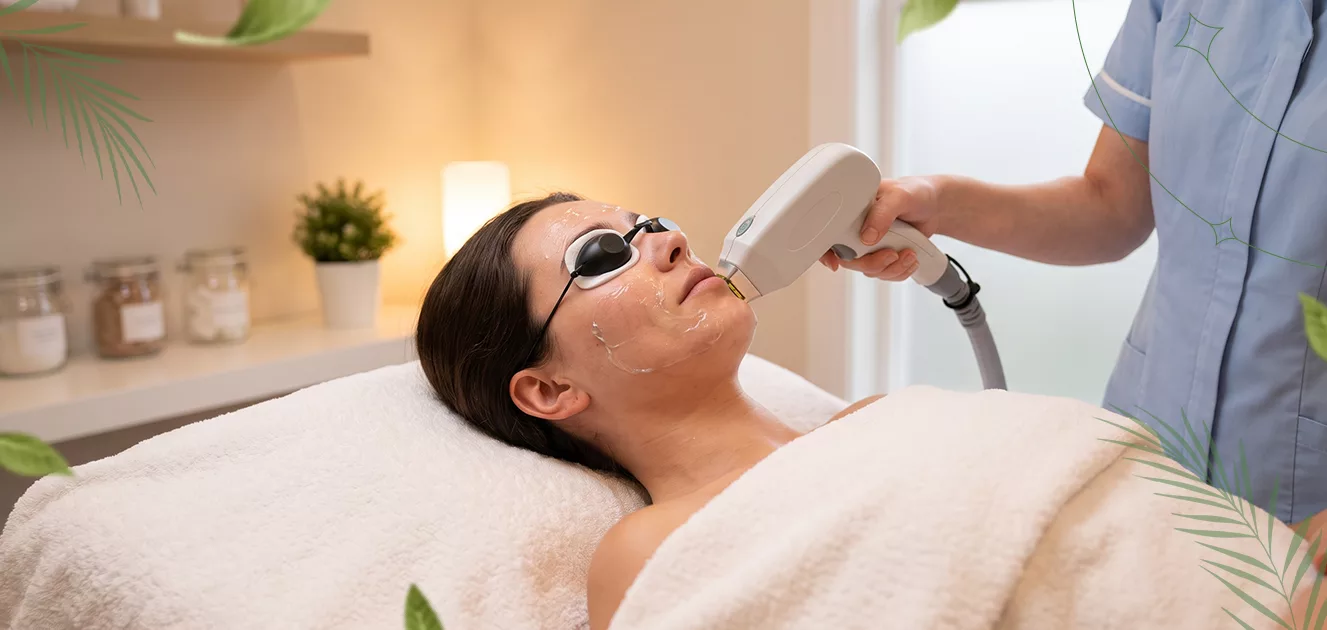
Facial hair is different from hair on your legs, arms, or underarms.
One person might have a few dark, coarse hairs on the chin. Another might have thicker growth along the jawline. Someone else may have a mixture of coarse hairs and very fine hair across the cheeks.
That difference matters when considering facial hair removal laser treatment.
Laser can provide long-term hair reduction when the hair and skin are suitable, but treating a larger area is not automatically better. Hair colour, thickness, facial area, skin tone, and hormonal influences all need to be considered before deciding what to treat.
If you are looking for laser treatment for facial hair removal in Greenwich, this guide explains the questions that matter before you book, including which facial hairs respond, whether fine hair should be treated, what happens between sessions, the possible risks, and the cost of facial hair laser treatment.
One clarification before we begin: in this guide, the term “laser facial treatment” refers to laser treatment to reduce facial hair. It does not refer to laser resurfacing, pigmentation treatment, or other skin-rejuvenation procedures.
Is your facial hair actually suitable for laser treatment?
Not every visible facial hair responds to laser in the same way.
Laser hair removal relies on pigment within the hair absorbing laser energy. That means the colour and thickness of the hair are important when deciding whether treatment is likely to be worthwhile.
The American Academy of Dermatology notes that laser hair removal does not effectively target blonde, white, grey, or red hair because these hairs lack sufficient pigment for the laser to target.
Coarse, dark facial hair
Dark, coarse hairs usually provide the clearest target because they contain more pigment.
Common examples include:
- Coarse chin hairs
- Dark upper-lip hair
- Thick hair around the jaw
- Beard-line hair
- Dark neck hair
This does not mean everybody with dark facial hair will get exactly the same result. Skin tone, hair-growth pattern, hormonal influences, and treatment settings still matter.
Fine facial hair and peach fuzz
Fine facial hair requires more careful consideration.
It can be tempting to see a “full face” treatment and assume that every visible hair should be lasered. That is not necessarily the best way to think about facial hair removal.
Very fine, lightly pigmented hair may provide a poor laser target. Treating an area simply because hair is visible is different from treating hair that is genuinely suitable for laser.
This is one reason a proper facial assessment matters.
Blonde, grey, white, and red facial hair
Very light hair can be difficult or impossible for standard hair-removal lasers to target effectively because there is little pigment available to absorb the laser energy. Meridian Spa’s current laser service information similarly states that laser works best on darker hair and is not effective on grey, white, and very fine, light-coloured hair.
If most of the hair you want removed is light, another hair-removal method may be more appropriate.
What if you have mixed facial hair?
This is common.
You might have thick, dark hairs on your chin but much finer hairs on your cheeks.
In that situation, the question is not simply:
“Can I have full-face laser?”
A better question is:
“Which parts of my facial hair are suitable for laser?”
Treatment can then follow your actual hair pattern, rather than treating every part of the face in exactly the same way.
Why can facial hair behave differently from body hair?
Facial hair can be more influenced by hormones than hair in many other areas.
This is particularly relevant around the chin, upper lip, jaw, and neck.
Hormonal changes can stimulate new hair growth even in follicles that previously responded well to treatment. This means successful laser treatment cannot prevent every new hormonally stimulated hair from appearing in the future.
For some people, facial hair reduction may therefore involve occasional maintenance.
Factors that may influence facial hair include:
- Age
- Genetics
- Hormonal changes
- Menopause
- Certain medical conditions
- Some medications
If you want a deeper explanation, Meridian Spa’s guide to how hormones influence hair growth and laser hair removal covers this topic separately.
Upper lip, chin, jawline, or full face: what actually needs treating?
Facial laser treatment can be tailored to the areas where unwanted hair appears.
| Facial concern | Area that may be assessed |
| Hair directly above the lip | Upper lip |
| Isolated coarse hairs below the mouth | Chin |
| Hair extending around the lower face | Chin and jawline |
| Dark hairs along the sides of the face | Side of face |
| Beard line or neckline hair | Cheeks and neck |
| Suitable hair across several areas | Full face |
The important point is simple:
More treatment area does not automatically mean better treatment.
If the unwanted hair is concentrated on your chin, treating your cheeks simply because they are part of a full-face package may not be worth it.
If suitable coarse hair appears across several areas, however, a broader treatment plan may be more practical.
Should you laser the whole face, or only the areas with coarse hair?
It depends on your facial hair pattern.
Full-face laser treatment can make sense when unwanted, laser-suitable hair is distributed across the upper lip, chin, cheeks, sides of the face or jawline.
Targeted treatment may be more appropriate when the concern is limited to one or two areas.
For example, somebody with ten noticeable coarse chin hairs and barely visible cheek hair may have different needs from somebody with dense dark growth across the lower face.
A good facial consultation should therefore look at the face area by area.
Questions to consider include:
- Which hairs are coarse enough to target?
- Which hairs contain enough pigment?
- Is the unwanted growth concentrated in one area?
- Would full-face treatment unnecessarily include fine hair?
- Is there a hormonal pattern to the growth?
- What result is realistic?
At Meridian Spa, a consultation and patch test are carried out before treatment to assess suitability and select treatment settings.
Can facial laser hair removal ever make hair appear worse?
Laser hair removal is designed to reduce hair, but there is an uncommon adverse effect that is particularly relevant when discussing facial treatment.
It is known as paradoxical hypertrichosis.
What is paradoxical hair growth?
Paradoxical hypertrichosis is increased hair growth that develops in or around an area treated with laser or intense pulsed light.
A 2021 systematic review and meta-analysis covering 9,733 patients found a pooled prevalence of about 3%. Importantly, for facial treatment, the review found that paradoxical hypertrichosis was strongly associated with treatment of the face and neck and was very uncommon outside those areas.
That does not mean 3% is the risk for every person booking facial laser treatment. The studies included different devices, populations and treatment approaches, and the review reported substantial variation between studies.
It does mean the possibility deserves to be discussed rather than ignored.
Why does facial assessment matter?
There is no single simple rule that predicts who will experience paradoxical growth.
That is another reason not to approach facial laser treatment as a one-size-fits-all service.
A practitioner should consider:
- The thickness of your facial hair
- The exact treatment area
- Your skin characteristics
- Hair density
- Your hormonal history
- Previous treatment response
- Appropriate laser settings
Fine hair around the face deserves particularly careful assessment.
Does paradoxical hair growth mean facial laser is unsafe?
No.
It means facial treatment needs appropriate candidate selection and a realistic discussion of benefits and risks.
All cosmetic procedures have limitations. A professional consultation should help determine whether laser is appropriate for your particular hair rather than simply assuming that all unwanted facial hair needs treatment.
Is laser treatment safe for facial hair?
Laser hair removal can be safely performed on suitable facial areas when the hair and skin are properly assessed, appropriate equipment and settings are used, eye protection is provided, and aftercare instructions are followed.
However, “safe” should never be interpreted as “completely risk-free.”
The American Academy of Dermatology notes that laser hair removal can cause burns, changes in skin colour and scarring when performed incorrectly. It recommends considering the practitioner’s experience with your skin colouring when deciding where to have treatment.
Face-specific considerations include:
- Skin tone
- Recent tanning
- Active irritation or infection
- Strong skincare products
- Prescription and non-prescription medication
- Previous reactions to laser
- Hair colour and thickness
- Treatment near the eyes
The eyebrows, eyelids and immediate eye area require particular caution because laser energy can injure the eyes.
At Meridian Spa in Greenwich, the current laser service uses the Candela GentleMax Pro, combining Alexandrite and Nd:YAG wavelengths. Treatment settings are selected following consultation and patch testing.
You can also read Meridian Spa’s existing guide on whether laser hair removal is safe for the face for more general safety information.
What happens to facial hair after each laser treatment?
Understanding what happens after an appointment can stop you from assuming the treatment has failed when hair remains visible.
Immediately after treatment
Your skin may feel warm or look slightly red.
Some people notice small areas of temporary swelling around individual follicles.
Your exact reaction will depend on your skin, treatment area and laser settings.
During the first few days
The skin normally begins settling.
This is when gentle aftercare matters. Avoid rubbing or irritating the treated area unnecessarily, and follow your practitioner’s instructions.
During the following days and weeks
Some treated hairs begin working their way out of the follicles.
This is commonly described as shedding.
The hairs do not necessarily disappear while you are sitting in the treatment room.
Before your next session
You may start seeing more facial hair again.
Some of this may be hair from follicles that were not in the right growth phase during your previous session.
This is why a course of treatment is normally required rather than a single appointment.
After several sessions
When treatment is working effectively, you may notice:
- Less dense hair growth
- Slower visible regrowth
- Finer hairs
- Patchier growth
- Less frequent need to remove hair
Results vary.
The face also warrants particular caution when discussing “permanent” results. The American Academy of Dermatology notes that women’s facial hair can behave differently from other treated areas and may require ongoing management.
Is the hair growing back or is it shedding?
Hair visible after laser does not automatically mean that the follicle has immediately produced new hair.
Treated hairs can remain in the skin for a period before being shed.
At the same time, other follicles can enter an active growth stage and produce hairs that were not effectively targeted during the previous session.
This creates a confusing period where you may see some hairs shedding while others appear to be growing.
Do not judge an entire course by how your face looks a few days after one appointment.
The better measure is the pattern over multiple sessions.
Are fewer hairs returning?
Is growth becoming finer?
Are you shaving less often?
Those changes tell you more than one isolated patch of visible hair.
Can I pluck facial hair after laser treatment?
Generally, no. Avoid plucking, waxing and threading facial hair during a laser treatment course unless your practitioner specifically tells you otherwise.
These methods pull hair from the follicle.
Laser treatment needs an appropriate target within the follicle. Constantly pulling hairs out from the root can interfere with the treatment process.
NHS laser hair-reduction guidance from Leeds Teaching Hospitals advises avoiding plucking and waxing during a laser treatment course, while allowing shaving according to the treatment protocol.
What if a chin hair appears between appointments?
Seeing dark chin hair before your next appointment can be frustrating, but resist the temptation to grab the tweezers.
Ask your practitioner when it is appropriate to shave or trim the area instead.
The exact shaving timetable may vary depending on the clinic’s treatment and aftercare protocol.
Can I thread my upper lip between laser sessions?
Threading removes hair from the root, so it presents the same problem as plucking and waxing.
If you normally thread your upper lip, you will usually need to stop while completing your laser course.
Meridian Spa’s current preparation guidance instructs clients not to wax, thread or pluck for at least four weeks before treatment because the follicle needs to remain intact.
Can you exercise after facial laser treatment?
It is sensible to avoid strenuous exercise immediately after facial laser treatment because heat, sweat and friction can aggravate recently treated skin. Follow the specific timeframe recommended by your practitioner.
This is especially relevant after facial treatment because sweat can sit directly on recently treated areas such as the upper lip, chin, jaw and neck.
Exercise can increase:
- Body temperature
- Facial flushing
- Sweating
- Rubbing from towels or clothing
- Skin irritation
Leeds Teaching Hospitals’ laser hair reduction protocol advises patients to avoid strenuous exercise, swimming, saunas, steam rooms, and hot baths or showers for seven days.
That does not mean every laser clinic uses the same seven-day protocol.
Laser systems, treatment settings and individual responses vary, so your own practitioner’s aftercare instructions should take priority.
If your face remains hot, swollen or irritated, returning immediately to a high-intensity workout is unlikely to be helpful.
Your face after laser: what about makeup, skincare and SPF?
Facial treatment creates one practical problem that leg or back laser does not:
Your normal skincare routine is applied directly to the treated area.
That makes post-treatment skincare important.
Can I wear makeup after a facial laser treatment?
Avoid rushing to cover temporary redness with layers of foundation immediately after your appointment.
Freshly treated skin can be sensitive, and rubbing during makeup application or removal may cause additional irritation.
Some NHS protocols recommend avoiding makeup for a defined period after treatment. Leeds Teaching Hospitals, for example, advises its laser patients to avoid makeup for 48 hours.
Follow the timeframe provided by your Meridian Spa practitioner for your treatment.
When can I restart retinol or exfoliating acids?
Strong active ingredients can irritate sensitive skin.
If you use retinoids, AHAs, BHAs, strong exfoliants or prescription facial products, mention these at your consultation.
Do not automatically restart them immediately after treatment.
Your practitioner can tell you when your skin is ready based on the products you use and how your face has responded.
Can I wash my face normally?
Keep the area clean but gentle.
Avoid aggressive scrubbing, exfoliating brushes and excessive heat while your skin is sensitive.
If your practitioner recommends a particular cleansing routine after your treatment, follow that advice rather than introducing new products.
Should I use SPF after facial laser treatment?
Sun protection is particularly important during a facial laser course because the face is exposed whenever you go outdoors.
The American Academy of Dermatology recommends sun protection before and during laser treatment and advises using broad-spectrum SPF 30+ sunscreen.
Meridian Spa also advises clients to avoid tanning and excessive sun exposure around appointments.
What should you do with facial hair between laser appointments?
Your routine between sessions can affect how smoothly the course progresses.
Do
- Follow your practitioner’s shaving instructions.
- Let treated hairs shed naturally.
- Keep your skincare gentle when the area is sensitive.
- Protect your face from excessive sun exposure.
- Tell your practitioner about medication changes.
- Attend sessions at the recommended intervals.
- Report unusual or persistent skin reactions.
Avoid
- Plucking
- Waxing
- Threading
- Picking at shedding hairs
- Tanning
- Irritating recently treated skin
- Restarting strong skincare too soon without guidance
The goal is not to “help” the laser by forcing hairs out.
Let the treatment process take its course.
How much does laser facial treatment cost in Greenwich?
Facial hair laser treatment cost depends primarily on which part of the face is being treated and how many appointments your individual treatment plan requires.
Meridian Spa currently lists the following facial laser hair removal prices in Greenwich:
| Facial area | Price per session |
| Upper lip | From £20 |
| Chin | From £20 |
| Side of face | From £30 |
| Neck | From £30 |
| Full face | From £50 |
| Cheeks for men | From £30 |
| Nose | From £20 |
| Between the brows for men | From £10 |
These are current per-session prices listed by Meridian Spa, with course packages available to discuss at consultation.
You can check the latest facial and body pricing on Meridian Spa’s laser hair removal treatment page.
Why the cheapest session is not always the cheapest treatment plan
Looking only at the price of one appointment does not tell you the total cost.
Your eventual spend can depend on:
- The facial area treated
- Number of sessions required
- Hair thickness
- Hair density
- How your hair responds
- Hormonal influences
- Whether maintenance is required
- Whether one or several facial areas need treatment
If you only have unwanted hair on the chin, paying for repeated full-face treatment may not be necessary.
That is why the first decision should be what actually needs to be treated, not simply which package has the lowest advertised price.
Spot treatment vs full-face laser: which costs less?
There is no single answer because the cheaper option depends on your hair pattern.
Imagine two people.
The first has a cluster of coarse chin hairs but virtually no unwanted hair elsewhere.
The second has suitable dark hair across the upper lip, chin and sides of the face.
The first person may be better served financially by treating only the chin.
The second may find full-face pricing more practical than combining several individual areas.
However, price is only one part of the decision.
If some of the hair in the full-face area is too fine or lightly pigmented to be a good laser target, treating a larger area simply to get a package price may not be worthwhile.
Suitability and cost need to be considered together.
When facial hair may need more than a laser appointment
Laser hair removal treats unwanted hair.
It does not diagnose why that hair appeared.
If you have always had a few dark hairs on your chin, that is very different from suddenly developing a significant amount of facial hair over a short period.
Consider speaking with a GP or other qualified healthcare professional if you notice:
- A rapid increase in facial hair
- A major change in your normal hair-growth pattern
- New facial hair alongside other unexplained symptoms
- Significant hormonal changes
- Persistent or worsening growth that concerns you
A dermatologist can also help investigate unexpected increases in unwanted hair and recommend appropriate hair-removal options.
Laser may still form part of cosmetic management when the hair is suitable, but reducing visible hair is not the same as treating an underlying hormonal or medical cause.
Laser hair removal or electrolysis for facial hair?
Laser is not the only professional option for unwanted facial hair.
The best method depends partly on the type of hair you want to remove.
Laser hair removal
Laser can be practical when there is a larger area of suitably pigmented hair.
It can target multiple follicles during a treatment session, making it useful for areas such as the chin, jaw, upper lip, beard line or neck when the hair responds well to laser.
Electrolysis
Electrolysis treats individual follicles using an electrical current.
One major advantage is that it can work on hair colours that lasers do not target effectively.
The American Academy of Dermatology states that professional electrolysis can permanently remove unwanted hair and can work on light-coloured hairs that laser cannot effectively remove.
It can therefore be worth discussing for:
- Grey facial hairs
- White hairs
- Very light hairs
- Individual remaining hairs
- Hairs that have not responded to laser
This is not a question of one treatment being universally “better.”
The right option depends on your hair.
What should you ask before booking a facial laser treatment?
A consultation is more useful when you know what to ask.
Use these questions before committing to a facial laser course:
- Is my facial hair suitable for laser treatment?
- Are you recommending my whole face or only specific areas? Why?
- Which laser and wavelength will be used for my skin and hair?
- Will you carry out a patch test before my full treatment?
- What result is realistic for my hair pattern?
- Could hormonal hair growth affect my results?
- How many sessions might my treatment require?
- What can I do with visible facial hair between appointments?
- Do I need to stop any skincare products?
- What will the total treatment cost look like for the areas I actually need?
The American Academy of Dermatology similarly recommends discussing expected results, likely number of treatments, potential side effects, skin colour, medical history and cost before laser hair removal.
Facial hair removal laser treatment in Greenwich, London
If you live in Greenwich, Deptford, Blackheath, Lewisham, New Cross, Greenwich Peninsula, Woolwich or nearby parts of South East London, facial laser treatment does not necessarily require travelling into Central London.
Meridian Spa provides laser hair removal at 38 Creek Road, London, SE8 3FN, in Greenwich.
The clinic’s current laser service uses the Candela GentleMax Pro, which combines Alexandrite (755 nm) and Nd:YAG (1064 nm) wavelengths. Facial treatment options include the upper lip, chin, full face, neck and other facial areas for women and men.
Before starting a course, the consultation gives you the opportunity to discuss your hair type, facial areas, skin, previous hair removal methods, medications, and realistic treatment goals.
The most useful starting point is not:
“How quickly can I laser my whole face?”
It is:
“Which of my facial hairs are actually worth treating?”
That one question can help you build a more appropriate treatment plan from the beginning.
FAQs about facial hair removal laser treatment
Is laser treatment safe for facial hair?
Laser treatment can be safely performed on suitable facial areas when appropriate equipment, settings, protective eyewear and aftercare are used. However, temporary redness and irritation can occur, while burns, pigment changes and scarring are possible complications. Your skin and hair should be assessed before treatment.
How much does laser facial treatment cost?
At Meridian Spa in Greenwich, current facial prices start from £20 for the upper lip, £20 for the chin, £30 for the side of the face and £50 for the full face per session. Your total cost depends on the areas treated and the number of appointments required.
Can I pluck facial hair after laser treatment?
Avoid plucking facial hair during your laser course unless your practitioner specifically advises otherwise. Plucking removes hair from the follicle, reducing the target needed for subsequent laser sessions. Shaving is normally the preferred way to manage visible growth between appointments when your skin is ready.
Can you exercise after facial laser treatment?
Avoid strenuous exercise immediately after treatment and follow your practitioner’s specific aftercare timeframe. Exercise raises skin temperature and causes sweating, which can irritate recently treated facial skin. NHS laser guidance also advises temporarily avoiding strenuous exercise and other heat-producing activities after treatment.
Can I shave my chin between facial laser sessions?
Usually, yes, once your treated skin has settled and your practitioner’s aftercare guidance allows it. Shaving removes hair at the skin level rather than pulling it from the follicle, making it more compatible with a laser course than waxing, threading or plucking.
Can I thread my upper lip after laser treatment?
Generally, threading should be avoided between laser appointments because it pulls hairs from their follicles. Meridian Spa currently advises clients not to thread, wax or pluck for at least four weeks before laser treatment. Follow your practitioner’s advice about shaving instead.
Why does my facial hair look like it is growing after laser?
Visible hair after treatment may be treated hair gradually shedding or new hairs entering an active growth stage. Not every follicle can be targeted effectively in a single appointment. Look at the reduction pattern across several sessions rather than judging the result a few days after treatment.
Can a laser make facial hair thicker?
In uncommon cases, increased hair growth, called paradoxical hypertrichosis, can occur after laser or light-based hair removal. Research has found that the effect is particularly associated with the face and neck. This is one reason fine facial hair should be carefully assessed before treatment.
Is laser suitable for fine facial hair?
Not always. Laser hair removal relies on pigment in the hair, so very fine or lightly pigmented facial hair may not provide a strong target. Suitability needs to be assessed by looking at the actual hair rather than assuming that all facial hair will respond equally well.
Should I laser peach fuzz on my face?
Do not assume peach fuzz needs a laser simply because it is visible. Very fine facial hair can be a poor target for laser treatment, and facial areas deserve careful assessment. Ask a practitioner whether the hair contains enough pigment and thickness to make laser treatment worthwhile.
Is it better to laser my whole face or just my chin?
Treat the areas where suitable unwanted hair actually exists. If coarse dark hair is limited to your chin, targeted treatment may be more appropriate. If suitable hair covers several facial areas, full-face treatment may be more practical. A consultation can help compare both options.
Can I wear makeup after facial laser hair removal?
Do not automatically apply makeup immediately after treatment. Recently treated skin can be sensitive, and rubbing can increase irritation. Aftercare protocols differ; some NHS guidance advises avoiding makeup for 48 hours. Follow the specific timeframe given by your laser practitioner.
How many facial laser sessions will I need?
There is no fixed number for everybody. The number of treatments depends on your hair colour, thickness, density, facial area, skin, hormones and treatment response. Multiple treatments are usually required because not all hairs are in the same growth stage at once.
Does hormonal facial hair grow back after laser?
Laser can reduce existing hairs, but it cannot stop hormonal changes from stimulating new follicles in the future. This is why some people with hormonally influenced facial growth may need maintenance treatments even after achieving a good initial reduction.
Is electrolysis better than a laser for facial hair?
It depends on the hair. Laser can be convenient for larger areas of suitable dark hair, while electrolysis can treat individual follicles and works on light-coloured hairs that laser does not target effectively. Grey, white or very light remaining facial hairs may therefore be better suited to electrolysis.
Ready to discuss facial laser hair removal in Greenwich?
The best facial laser plan begins with understanding which hairs need treatment, not automatically treating every visible hair.
At Meridian Spa in Greenwich, your facial hair pattern, skin and treatment areas can be assessed before your course begins. A consultation and patch test help determine whether areas such as your upper lip, chin, neck, cheeks or full face are suitable for treatment.
Explore Meridian Spa’s laser hair removal treatments in Greenwich or book a consultation to discuss your facial hair concerns and the most appropriate treatment plan.